

Skip to content
  1. 01One task
  2. 02Look first
  3. 03Safe pause
  4. 04Clear rules
  5. 05Proof
  6. 06Trust
  7. 07Rules
  8. 08Yours
  9. 09Research
  10. 10Nine words
  11. 11What you own

How it works

Concept, not stack

The AI is the least interesting part.

A Falnor system is built to be relied on. It looks before it acts, stops before anything that cannot be undone, and keeps a record of every decision. These seven principles hold true whichever AI sits underneath.

Engraving of an architect kneeling over a plan with dividers, an aqueduct behind him
  1. 01Look before acting
  2. 02Pause safely before big steps
  3. 03Clear rules decide, not the AI
  4. 04Proof, not guesswork
  5. 05Trust is earned and can be taken back
  6. 06Rules come from your decisions
  7. 07It runs where your data lives

One task

Six steps

How one task moves.

Every task goes through the same six steps. The first three change nothing. The check in the middle decides whether the last three are allowed to happen.

PERSON CHECKCHANGES NOTHINGMAKES CHANGES, CHECKED FIRSTArrivesLooksDecidesChecksActsRecords
Looking: always allowedMaking changes: allowed step by step, once trusted

Seven principles

01 to 07

What every Falnor system is built on.

None of these depend on a particular AI. Together they are why a system can be trusted to keep work moving without someone pushing it.

Fig. 00 Each time round, less needs a person. Numbers show approvals a week

DecideSuggestApproveCheck64279Step backFewer approvalseach time round
  1. Decide

    A person answers once

  2. Suggest

    The system suggests a rule

  3. Approve

    Signed off. Fewer requests

  4. Check

    Every change is checked

  5. Step back

    A mistake moves it back out a lap

01

Look before acting

At first, the system can only read your software, never change it. It is allowed to update things one system and one task at a time, once it has shown it understands your real cases.

What it means for youNothing in your business can be changed by a system that has not first proven it reads things correctly.

Fig. 01

What it may do, system by system

It can look everywhere. It can change two, and it earned that.

Customer recordsLook only
Service deskLook only
AccountsLook only
EmailLook only
DocumentsLook only
ChatLook only

02

Pause safely before big steps

Before anything that cannot be undone, the system saves exactly where it is. If it needs a person, it waits at that point and picks up from there when they reply, even hours later or after a restart.

What it means for youAn approval is never lost, and nothing is ever done twice.

Fig. 02

One decision, waiting safely

Waited almost 5 hours. Done once.

  1. 09:14Checked Xero, the email and the customer record
  2. 09:14Rule: refunds over £500 go to Ngozi
  3. 09:14Progress saved. Waiting for Ngozi
  4. 11:40System restarted. Nothing lost
  5. 14:02Ngozi approves from her phone
  6. 14:02Credit note issued, once
  7. 14:02Record saved. Task closed

03

Clear rules decide, not the AI

The AI never approves its own actions. Each time it wants to do something, a separate set of rules checks it and answers yes, ask a person, or no. Your team can read those rules.

What it means for youPermission comes from rules you can see, not from an AI that can be talked round.

Fig. 03

Three requests, one set of rules

The rules decide, not the AI.

Issue a £180 refund on invoice 4471
Allowed. Rule: refunds under £200 are approved
Yes
Email the customer
No rule yet, and the customer will see it
Ask
Delete invoice 4471
Not allowed. It may never delete invoices
No

04

Proof, not guesswork

A confidence score is only a feeling. Every step is checked against what actually happened: what the system looked at, what it changed and the rule that allowed it. If something does not add up, it is flagged, not hidden.

What it means for youWhen your auditor or a customer asks why, you can show them the record.

Fig. 04

One thing the system said it did

Checked against what really happened.

Posted credit to invoice 4471

SourcesXero invoice 4471, email of 14 Aug, customer record 2291ChangeCredit note CN-882 added to invoice 4471RuleRefunds under £200: approveApproved byNgozi, who set up this rule
Confidence: 87%Not stored

05

Trust is earned and can be taken back

Every system starts by only watching and suggesting, while a person still does the work. It is given more to do in small steps, only when the results prove it is ready. Your team signs off each step up. If it ever gets something wrong, it steps back automatically.

What it means for youTrust is built on a track record, not switched on in the settings.

Fig. 05

How much it is trusted to do, over time

Your team signs off each step up. Stepping back is automatic.

0 Watching1 Supervised2 Trusted with tasks3 Fully trustedW1W4W8W12W16Mistake spotted on one invoice. Stepped backMatched the team 91%Signed off: refunds under £200Signed off: more tasks

06

Rules come from your decisions

When your team answers the same question the same way, the system suggests turning it into a rule. Someone approves it, and fewer requests need a person, for a reason you can see and undo.

What it means for youThe number of approvals your team handles goes down week by week, and every drop is explained.

Fig. 06

Approvals your team handles each week

Each drop comes from a named rule.

020406064W158W241W338W427W524W617W715W811W99W10
  1. W3Refunds under £200: approve
  2. W5Duplicate claim: merge and let the customer know
  3. W7Refunds £200 to £500: approve if no past issues
  4. W9New supplier: ask Tomasz

07

It runs where your data lives

It runs on your own systems, so your data stays where it is, in the US, UK or EU if that is where you keep it. Its links to your software, its rules, its records and your test cases all belong to you. If the AI underneath changes, we re-test on your cases before anything goes live.

What it means for youYou can change the AI, the supplier, or us, and keep the system.

Fig. 07

What belongs to whom

Navy is yours. The AI is just a part you can replace.

Software linksYour systems
RulesEasy to read
Full recordKept by you
Test casesYour cases
Spending limitPer system
The AICan be swapped

The bigger picture

With sources

Why most AI projects stall, and what the successful ones do first.

Independent research tells the same story. Businesses are adopting AI faster than they are putting checks around it, and most projects never get past the trial. The problem is rarely the AI itself. It is how the work is mapped, checked and owned, which is what Falnor is built around.

  • 0%+of AI projects that act on their own will be scrapped by the end of 2027, mostly on cost or unclear valueGartner, June 2025
  • 0%of company AI trials make a measurable difference to the bottom lineMIT, The GenAI Divide, 2025

Businesses are adopting AI faster than they are putting checks around it

Share of organisations. Deloitte, State of AI in the Enterprise, 3,235 leaders, 2026.

74%Plan to use it23%Use it today21%Have checks53-ptgap

Who builds it decides whether it goes live

Share of projects that went live. MIT, The GenAI Divide, 2025.

67%Specialist partner33%In-house

Based on interviews with 52 organisations. The authors note the gap may partly reflect how well each organisation was set up.

  • Businesses with weaker checks are more likely to find out about an AI mistake only after it has caused a problem.
  • Many businesses using AI do not review everything it produces before it is used.
  • Many products sold as AI assistants are older automation or chatbots with a new label. It is worth asking what is underneath.

Nine words

One language

Everything in the system is one of nine things.

If you know these nine words, you can follow everything the system does. Your industry supplies the name for the task; the rest stays the same.

Engraving of an aqueduct carrying water along stone arches into a walled hilltop town
01

Item

The thing being worked on. A claim, a support request, an invoice.

02

Workflow

The steps an item goes through, in order.

03

Run

One item going through its workflow once.

04

Step

One small action inside a run, such as checking a record.

05

Task

An item and where it has got to, as your team sees it.

06

Decision

A point where the system stopped and asked a person.

07

Rule

A standing answer, learned from your team’s past decisions.

08

Level

How much the system is trusted to do on its own. Earned, not set.

09

Evidence

What the system looked at and where it found it. Never a guess.

What you own

Exit pack included

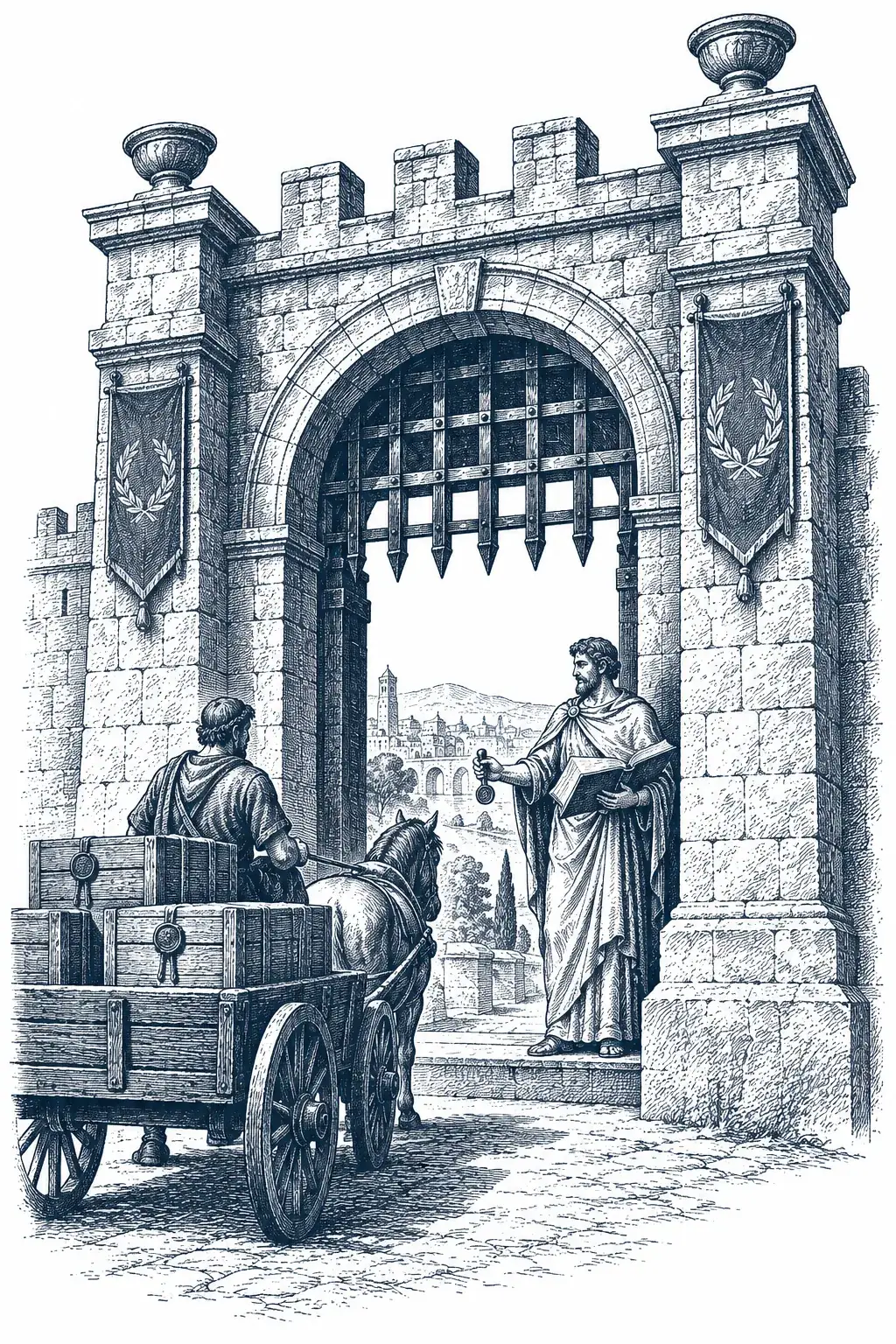
Engraving of a gatehouse with a raised portcullis and a keeper holding a ledger

Built on your systems. Yours from day one.

Handing it over is part of the job, not an extra. Everything the system runs on stays with you, and your team knows how to run it.

  1. From day one

    It runs on your systems

    Your software, your accounts, your data. Nothing moves across to us.

  2. At handover

    Your team takes the keys

    A walkthrough and the exit pack: every connection, rule and test case, written in plain files.

  3. Any day after

    It keeps going without us

    Your team can change a rule, swap the AI or switch it off in one click. No call to us needed.

Book a discovery call

One process, the software it uses, and a straight answer on whether we can help.